
Crypto Trading Indicators Explained
Dorin Sufana is the founder of ETH Signal and builds and operates its live crypto signal engine covering ETH, BTC and SOL.
See our transparent signal performance, read more on the blog, or get in touch.
This is a plain-English guide to the crypto indicators behind modern trading signals, written by the team running a live engine on ETH, BTC and SOL. No single indicator is used alone. Reliable setups look for confluence between trend, momentum and volatility.
EMA (Exponential Moving Average)
What it is
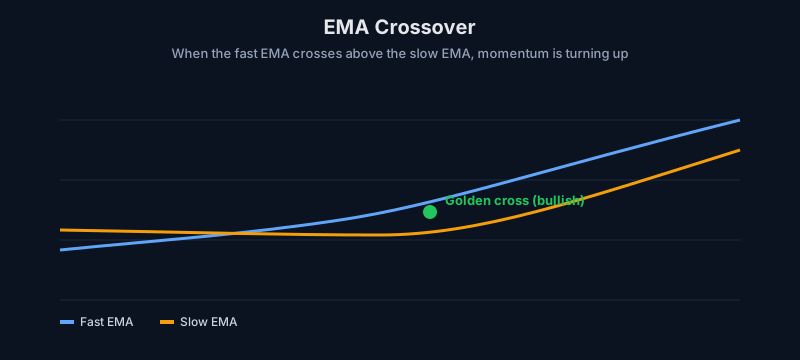
An EMA is a moving average that weights recent candles more heavily than older ones, so it reacts faster to fresh price action. Traders typically plot at least two, a fast EMA and a slow EMA, to read the trend.
What it tells you
Price above a rising EMA suggests an uptrend; price below a falling EMA suggests a downtrend. When a fast EMA crosses above a slow EMA it is often called a golden cross; the opposite is a death cross.
How ETH Signal uses it
ETH Signal uses EMA relationships as a trend filter. Long setups need supportive EMA structure across the timeframe being traded and the timeframe above it.
Limitations
EMAs are lagging by construction and can whipsaw in sideways markets, so we never trade an EMA crossover on its own.
SMA / Moving Averages
What it is
A Simple Moving Average is the plain arithmetic mean of the last N closing prices. It is the smoothed baseline that many other indicators are built on top of.
What it tells you
SMAs show the underlying trend with the sharpest noise removed, which is useful for identifying broad regime: bullish, bearish or ranging.
How ETH Signal uses it
We use SMAs as a slower reference against faster EMAs, and as the middle line of volatility envelopes such as Bollinger Bands.
Limitations
The EMA reacts faster than the SMA, so an SMA alone is too slow for scalping timeframes like 1m and 5m.
MACD
What it is
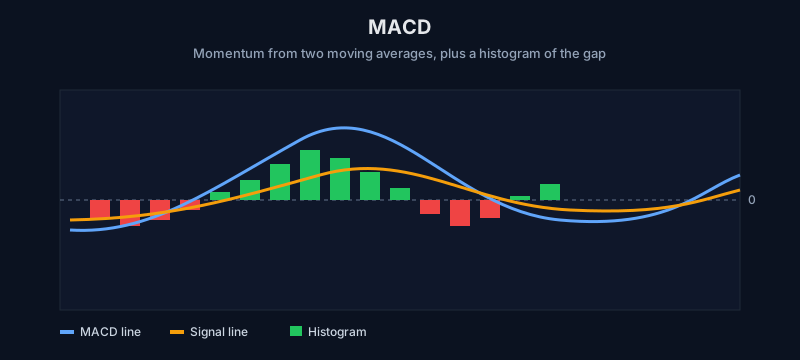
MACD (Moving Average Convergence Divergence) is calculated from the gap between two EMAs, with a signal line and a histogram of the difference. It is a momentum indicator, not a trend indicator.
What it tells you
The MACD line crossing above the signal line hints at building bullish momentum; crossing below hints at bearish momentum. The histogram shows whether that momentum is accelerating or fading.
How ETH Signal uses it
In our engine, MACD is normalised against volatility (see ATR in the glossary) rather than used as a raw price value, so the same threshold behaves consistently across BTC, ETH and SOL.
Limitations
MACD is derived from lagging averages, so it confirms moves rather than predicting turns; in chop it produces frequent false crossovers.
RSI (Relative Strength Index)
What it is
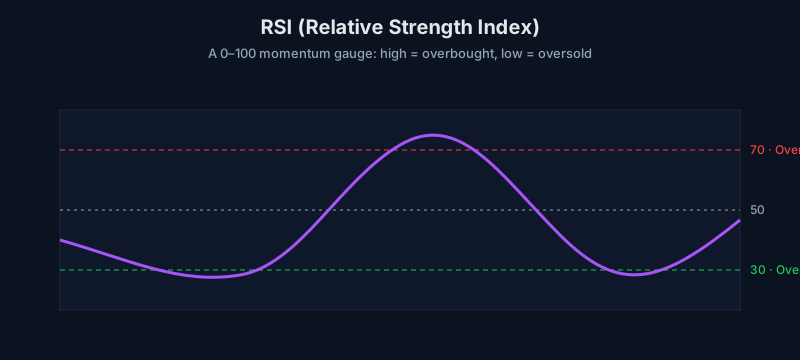
RSI is a 0 to 100 momentum oscillator comparing the size of recent up-moves to recent down-moves over a lookback window (commonly 14 candles).
What it tells you
Readings above 70 are conventionally called overbought (the market may have risen too fast); below 30 is oversold. Divergences between RSI and price often precede reversals.
How ETH Signal uses it
We use RSI as one of several momentum inputs, and pay more attention to structure (higher lows in RSI while price makes lower lows) than to the raw 30/70 lines.
Limitations
In a strong trend RSI can stay overbought or oversold for a long time; treating those readings as automatic reversal signals is a classic beginner mistake.
Stochastic RSI
What it is
Stochastic RSI applies the stochastic oscillator formula to RSI itself, giving a more sensitive read of where RSI sits within its own recent range.
What it tells you
Because it is a derivative of a derivative, Stoch RSI reacts more quickly than plain RSI, useful for spotting momentum flips inside an existing trend.
How ETH Signal uses it
We use Stoch RSI mostly as a lower-timeframe timing input, never as a standalone entry trigger. It is too noisy on its own.
Limitations
That same sensitivity means Stoch RSI whips between 0 and 100 constantly, so it generates many signals that other indicators must filter out.
ATR (Average True Range)
What it is
ATR measures how much an asset typically moves per candle, including gaps. It is a pure volatility measure. It says nothing about direction.
What it tells you
A rising ATR means the market is expanding; a falling ATR means it is contracting. That directly changes what a realistic stop or target distance looks like.
How ETH Signal uses it
ATR is how ETH Signal sizes stop losses and take-profit distances so that a 5m BTC setup and a 1H SOL setup are internally consistent. Targets scale with the asset's own volatility.
Limitations
ATR is not predictive. A low ATR does not mean a big move is coming, it just means the recent past was quiet.
Bollinger Bands
What it is
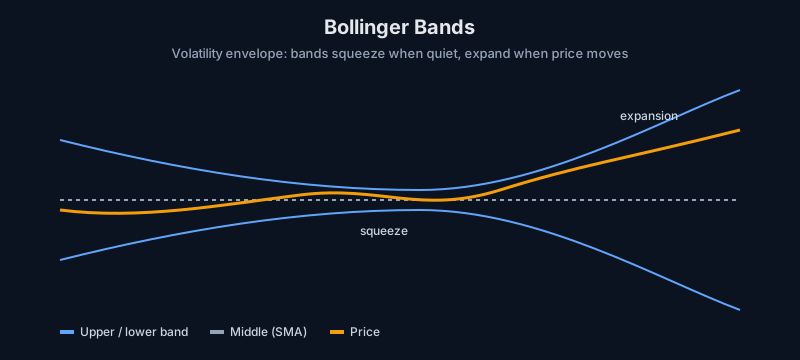
Bollinger Bands plot a middle SMA with upper and lower bands set a number of standard deviations away, so the envelope widens and contracts with volatility.
What it tells you
Bands squeezing together often precede a decisive move; price riding one band tends to indicate a strong trend rather than exhaustion.
How ETH Signal uses it
We treat a squeeze followed by an expansion as a context flag. It does not choose direction, but it tells us a range is ending and a move is likely.
Limitations
Bollinger Bands describe volatility, not direction, so band touches are not reversal signals on their own.
Volume
What it is
Volume is the number of units traded during each candle. It is not a smoothed calculation. It is a direct measurement of participation.
What it tells you
A move accompanied by rising volume is usually a stronger signal than the same move on thin volume, which is more easily faded.
How ETH Signal uses it
We use volume as a confirmation layer. A breakout without a supporting volume reaction is treated with more scepticism than one with clear participation.
Limitations
Crypto volume varies by venue and can be distorted by wash trading; we cross-check across major venues rather than trusting a single source.
Why we combine them (confluence)
No single indicator is reliable on its own. Trend tools like EMAs lag; momentum tools like RSI and MACD whipsaw in chop; volatility tools like ATR and Bollinger Bands describe context but not direction. A durable setup requires confluence: agreement across trend, momentum and volatility, usually confirmed on more than one timeframe. For a full walk-through of how we assemble that logic into live BUY, SELL and WAIT verdicts, read how our signals work.
FAQ
What are the best indicators for crypto trading?
There's no single best one. Reliable setups usually combine a trend indicator (like EMA), a momentum indicator (like RSI or MACD) and a volatility measure (like ATR or Bollinger Bands). ETH Signal looks for agreement across several rather than trusting any one alone.
What do RSI overbought and oversold mean?
RSI runs 0 to 100. Above 70 is often called overbought (price may have risen too fast); below 30 is oversold (may have fallen too fast). They flag possible turning points, not guaranteed reversals.
What is an EMA crossover?
When a faster EMA crosses above a slower one it can signal upward momentum (a 'golden cross'); crossing below can signal the opposite. It's a common trigger but works best confirmed by other indicators.
Is this financial advice?
No. This page is educational only. Crypto trading carries significant risk of loss and nothing here is financial advice.
Want proof rather than theory? See how these indicators perform in real signals.
Risk Disclaimer
This article is educational content only and is not financial, investment or legal advice. Cryptocurrency trading carries significant risk of loss. Past performance of any signal does not guarantee future results. Always do your own research and consider consulting a licensed financial adviser before making investment decisions. Never trade with funds you cannot afford to lose.