
How We Measure Performance
Dorin Sufana is the founder of ETH Signal and builds and operates its live crypto signal engine covering ETH, BTC and SOL.
See our transparent signal performance, read more on the blog, or get in touch.
This page explains exactly how the win rate on our performance page is calculated — and what we deliberately leave out. The whole point is transparency: you should be able to read this and reproduce the maths yourself.
1. The one metric we report
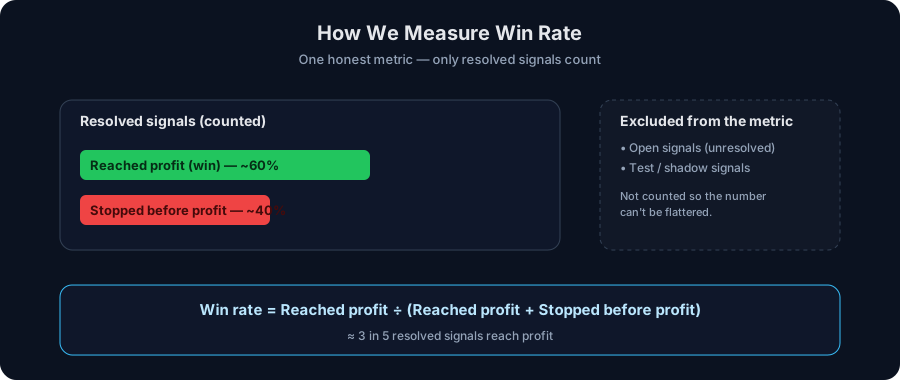
We report a single, pooled win rate. It is calculated as: signals that reached profit ÷ (signals that reached profit + signals that stopped before profit). We frame it publicly as roughly 3 in 5 — an honest, realistic number rather than a marketing figure.
2. What counts as a win
A signal is a win if it reaches profit after firing — i.e. price travels far enough in the signal's direction to hit its first take-profit level. If it hits its stop loss first, it is counted as a loss. Nothing else. There is no partial credit, no "close enough" bucket, and no manual override.
3. What we exclude and why
Two categories are deliberately kept out of the metric:
- Open (unresolved) signals — their outcome isn't known yet, so counting them would distort the figure either way.
- Test / shadow signals — these are new configurations that ran live but were never shown to subscribers (see how our signals work). Including them would let us flatter the number with attempts nobody could ever trade.
4. What we don't do
No cherry-picking. We do not showcase our best asset or best timeframe as if it were representative of the whole; the reported number pools every qualifying signal. We do not hide losers, and we do not swap the metric for a vanity number (pips gained, theoretical PnL, best-week screenshots). If you can't reproduce a stat from resolved signals, we won't publish it.
5. Why win rate isn't everything
Win rate on its own is an incomplete picture. It doesn't say anything about risk-reward or drawdown. A strategy with a 45% win rate but winners that are twice the size of its losers is more profitable than a 70% strategy whose losers dwarf its winners. This is the first thing to understand before comparing any two signal services — and it's why our risk management guide matters as much as the score itself.
6. Live setups vs replay model — why we show both
Some timeframes are measured from actual live setups. Others are measured by replaying the current signal model over historical candles. Replay helps compare the current model across different market conditions, but it does not mean every historical setup was sent as a live alert at that time.
- 5m and 1D use actual live setup history.
- 1m, 30m and 1H use the current replay model over historical candles.
- Replay includes losing trades as well as winning trades.
- When a lane is enabled today, replay may show how that same model would have behaved before it was live.
- Live alerts depend on when a lane was actually enabled.
7. See it live
The number on the performance page is computed exactly as described above — no different maths, no cleaned-up subset. Every resolved signal we broadcast is in the denominator; every one that reached profit is in the numerator. If we ever change the formula, this page and the performance page get updated in the same release.
FAQ
How is the ETH Signal win rate calculated?
It's the share of resolved signals that reached profit, calculated as reached profit divided by (reached profit plus stopped before profit). Open signals and internal test signals are excluded, so the number reflects only real, finished trades.
Are replay rows the same as trades I would have received alerts for?
No. Replay rows show how the current model would have behaved on historical candles. Live alerts depend on when that lane was enabled and running in production.
Why are open signals excluded from the win rate?
Because their outcome isn't known yet. Counting unresolved trades would distort the figure in either direction, so only signals that have fully played out are included.
Is a 60% win rate good for crypto signals?
Around 3 in 5 is a solid, realistic figure, but win rate alone doesn't tell the whole story. Risk-reward and drawdown matter just as much; a strategy can be profitable at a lower win rate if its winners are larger than its losers.
Do you cherry-pick your best results?
No. The metric pools all qualifying signals rather than showcasing the best asset or timeframe, and losing trades are included. The goal is an honest number, not a flattering one.
Is this financial advice?
No. This page is educational only. Crypto trading carries significant risk of loss and nothing here is financial advice.
Want to see the number now? Open the live performance page.
Risk Disclaimer
This article is educational content only and is not financial, investment or legal advice. Cryptocurrency trading carries significant risk of loss. Past performance of any signal does not guarantee future results. Always do your own research and consider consulting a licensed financial adviser before making investment decisions. Never trade with funds you cannot afford to lose.