Crypto Trading Glossary
Dorin Sufana is the founder of ETH Signal and builds and operates its live crypto signal engine covering ETH, BTC and SOL. These definitions come from day-to-day work running real trading signals.
Reviewed by the ETH Signal research desk. See our transparent signal performance, read more on the blog, or get in touch.
This is a plain-English crypto trading glossary covering over 90 crypto trading terms, from HODL and market cap to take profit, stop loss, support and resistance and win rate. It's built for signal traders and beginners by the team running a live crypto signal engine.
A
Airdrop
A free distribution of tokens to wallets, often to reward early users or promote a project.
Altcoin
Any cryptocurrency other than Bitcoin. ETH and SOL are the two altcoins ETH Signal covers alongside BTC.
APY
Annual Percentage Yield: the yearly return on a crypto holding through staking or lending, including compounding.
Arbitrage
Profiting from the same asset trading at different prices across exchanges.
Ask / Bid
The ask is the lowest price a seller will accept; the bid is the highest a buyer will pay. The gap is the spread.
ATH / ATL
All-Time High and All-Time Low: the highest and lowest prices an asset has ever reached.
ATR
Average True Range: a volatility measure of how much an asset typically moves; signals often size stops and targets relative to ATR.
B
Backtest
Testing a strategy against historical data to estimate how it would have performed. ETH Signal validates configs by backtesting before going live.
Bear Market
A prolonged period of falling prices and negative sentiment.
Blockchain
A distributed digital ledger that records transactions across many computers. It is the base layer all crypto runs on.
Bollinger Bands
A volatility indicator plotting bands above and below a moving average; price reaching a band can signal overextension.
Breakeven
The point where a trade's stop loss is moved to the entry price, so it can no longer lose money.
Breakout
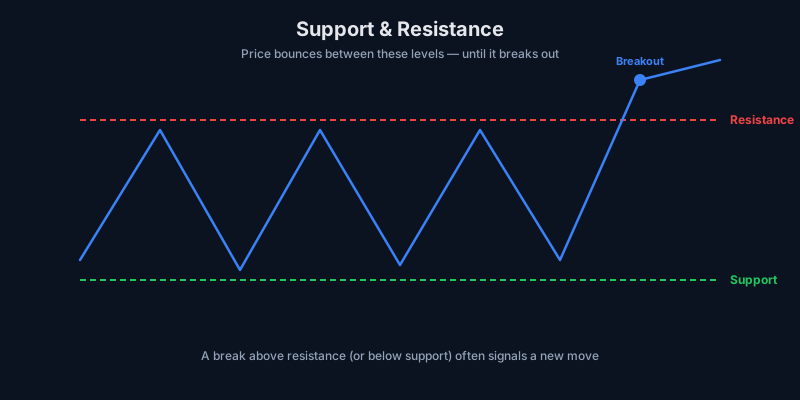
When price moves decisively beyond a support or resistance level, often signalling a fresh move.
BTC (Bitcoin)
The first and largest cryptocurrency by market cap, and one of the three assets ETH Signal tracks.
Bull Market
A prolonged period of rising prices and optimism.
Buy Wall / Sell Wall
A large cluster of buy or sell orders at one price that can slow or stall price movement.
C
Candlestick
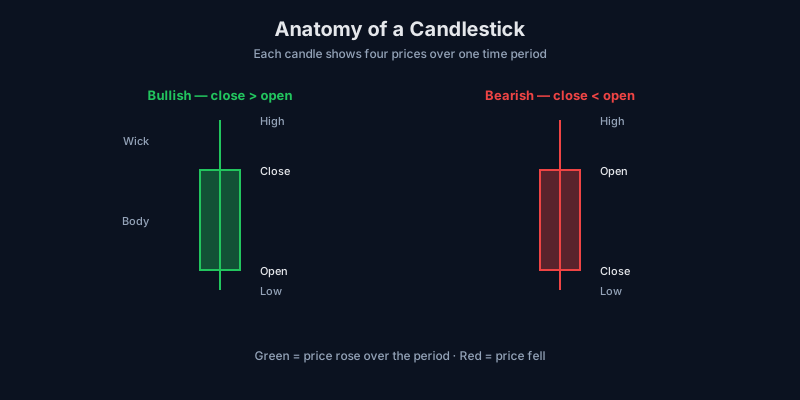
A chart element showing the open, high, low and close price for a period (e.g. a 5-minute or 1-hour candle).
CEX / DEX
A CEX (centralised exchange, e.g. Binance) is company-run; a DEX runs on smart contracts with no middleman.
Coin vs Token
A coin has its own blockchain (BTC, ETH); a token is built on top of another chain.
Cold Wallet
A crypto wallet kept offline (often hardware) for maximum security, versus a hot wallet.
Confluence
When multiple indicators or signals point the same way, strengthening the case for a trade.
Consolidation
A period where price trades sideways in a tight range before its next move.
D
Day Trading
Opening and closing trades within the same day to capture short-term moves.
DeFi
Decentralised Finance: financial services built on blockchains using smart contracts instead of banks.
Divergence
When price and an indicator (e.g. RSI) move in opposite directions, often hinting at a reversal.
Diversification
Spreading capital across multiple assets to reduce overall risk.
Drawdown
The peak-to-trough drop in an account or strategy's value; lower drawdown means a smoother equity curve.
DYOR
"Do Your Own Research": a reminder to verify before trading rather than just following others.
E
EMA
Exponential Moving Average: a trend indicator weighting recent prices more heavily; EMA crossovers are a common signal trigger.
Entry
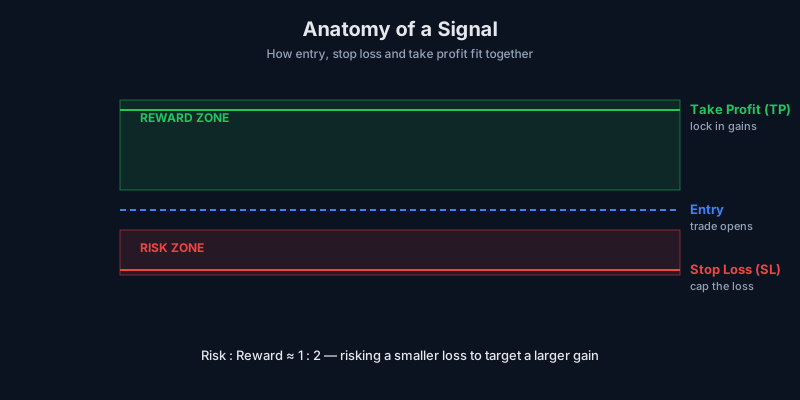
The price at which a trade is opened; alerts specify an entry alongside a take profit and stop loss.
ETH (Ethereum)
The second-largest cryptocurrency and ETH Signal's primary asset; the leading platform for smart contracts and DeFi.
F
Fiat
Government-issued currency such as GBP, USD or EUR, as opposed to crypto.
Fibonacci Retracement
A tool using ratios (e.g. 61.8%) to identify potential support and resistance levels.
Fill
The completion of a buy or sell order at a given price; a partial fill means only part executed.
FOMO / FUD
FOMO = Fear Of Missing Out; FUD = Fear, Uncertainty and Doubt (negative, often exaggerated, sentiment).
G
Gas
The fee paid to process a transaction on a blockchain, most associated with Ethereum; higher demand means higher gas.
Gwei
A small denomination of ETH used to price gas fees (1 Gwei = 0.000000001 ETH).
H
Halving
A scheduled event (notably Bitcoin's) that cuts mining rewards in half, reducing the rate of new supply.
HODL
Slang for holding long-term rather than selling; originally a misspelling of "hold".
Hot Wallet
A crypto wallet connected to the internet; convenient for trading but less secure than a cold wallet.
K
KYC
"Know Your Customer": the identity verification exchanges require to comply with regulations.
L
Ledger
A record of transactions; also a well-known brand of hardware wallet.
Leverage
Borrowed capital used to increase position size; it amplifies gains and losses and raises liquidation risk.
Limit Order
An order to buy or sell at a specific price or better, rather than immediately.
Liquidation
The forced closure of a leveraged position when losses exceed the available collateral.
Liquidity
How easily an asset can be bought or sold without moving the price; BTC and ETH are highly liquid.
Long / Short
Going long profits if price rises; going short profits if price falls.
M
MACD
Moving Average Convergence Divergence: a momentum indicator built from moving averages, best normalised against volatility.
Margin
Funds borrowed to open a larger position than your own capital allows (see leverage).
Market Cap
The total value of a cryptocurrency: price multiplied by circulating supply.
Market Order
An order that executes immediately at the best available price.
Mining
Using computing power to validate transactions and secure a proof-of-work blockchain.
Momentum
The speed and strength of a price move; many indicators exist to measure it.
Moving Average (SMA)
The average price over a set number of candles, smoothing out noise to reveal the trend.
N
NFT
Non-Fungible Token: a unique blockchain token representing ownership of a specific item.
Node
A computer running a blockchain's software, helping validate and relay transactions.
O
Oscillator
An indicator that moves within a range (e.g. RSI, Stochastic) to show overbought or oversold conditions.
Overbought / Oversold
Conditions suggesting an asset may have risen or fallen too far, too fast, and could reverse.
P
Paper Trading
Practising trades with fake money to test a strategy without real risk.
Portfolio
The full collection of assets you hold.
Position Sizing
Deciding how much capital to risk on a single trade. This is a core risk-management skill.
Private Key
The secret code that controls a wallet and its funds; never share it.
Proof of Stake / Proof of Work
The two main methods blockchains use to validate transactions and secure the network.
Public Key / Address
The shareable code others use to send you crypto.
Pump and Dump
A scheme that inflates a price with hype, then sells on latecomers.
R
Resistance
A price level where selling tends to cap upward moves.
Retest
When price returns to a broken level to confirm it before continuing.
Risk-Reward Ratio
The ratio between a trade's potential loss (to the stop loss) and potential gain (to the take profit); 1:2 risks one to make two. See our risk management guide.
ROI
Return On Investment: the percentage gain or loss on a trade or portfolio.
RSI
Relative Strength Index: a momentum oscillator (0 to 100) showing whether an asset may be overbought or oversold.
Rug Pull
A scam where developers abandon a project and drain its funds.
Runner
A portion of a position left open after taking profit, to capture further upside.
S
Safe Mode
A conservative signal configuration adding an extra confirmation filter, trading a little profit for meaningfully lower drawdown.
Sats (Satoshis)
The smallest unit of Bitcoin (1 BTC = 100,000,000 sats).
Scalping
A very short-term style aiming for many small, quick profits.
Seed Phrase
A set of words that backs up and restores a wallet: the master key. Keep it offline and secret.
Signal
An actionable trade alert specifying an asset, direction, entry, take profit and stop loss on a given timeframe. See what is a crypto signal.
Slippage
The difference between a trade's expected price and its actual fill price, common in fast or low-liquidity markets.
Smart Contract
Self-executing code on a blockchain that runs automatically when conditions are met; the foundation of DeFi.
SOL (Solana)
A high-speed, low-fee blockchain and cryptocurrency, and the third asset ETH Signal tracks.
Spread
The gap between the bid and ask price; tighter spreads mean cheaper entries and exits.
Stablecoin
A crypto pegged to a stable value such as the US dollar (e.g. USDT, USDC).
Staking
Locking up crypto to help secure a proof-of-stake network in exchange for rewards.
Stochastic RSI
A momentum oscillator applying the Stochastic formula to RSI for more sensitive overbought/oversold reads.
Stop Loss (SL)
A preset price at which a losing trade is automatically closed to cap the loss; a core risk tool on every signal. See stop loss guide.
Support
A price level where buying tends to halt downward moves.
Swing Trading
Holding trades for days to weeks to capture larger moves than day trading.
T
Take Profit (TP)
A preset price at which a winning trade is closed to lock in gains; strategies may use tiers (TP1, TP2, TP3) to scale out. See TP1/TP2/TP3 explained.
Timeframe
The candle interval a signal is based on: 5-minute (5m), 30-minute (30m) or 1-hour (1H); shorter fires more often, longer is steadier. Compare in our timeframe guide.
Trend
The general direction of price over time: up (bullish), down (bearish) or sideways (ranging/chop).
V
Volatility
How sharply and quickly a price moves; crypto is highly volatile, creating both opportunity and risk.
Volume
The amount of an asset traded over a period; rising volume often confirms the strength of a move.
W
WAIT
A signal state meaning no trade is currently recommended; the engine is holding off until conditions align. See what is a WAIT signal.
Wallet
Software or hardware that stores the keys needed to access your crypto (see hot wallet and cold wallet).
Whale
A holder with enough crypto to move the market when they buy or sell.
Whipsaw
A sharp price move in one direction then the other, often stopping traders out.
Win Rate
The share of resolved signals that reach profit: profitable divided by (profitable + stopped-out); around 3 in 5 means roughly 60% of resolved signals hit profit.
FAQ
What is a crypto glossary?
A crypto glossary is a reference list that defines the jargon used in cryptocurrency and trading, covering terms like blockchain, HODL, take profit and stop loss, so beginners can quickly understand what everything means.
What do TP and SL mean in crypto trading?
TP (take profit) is the price at which a winning trade is closed to lock in gains; SL (stop loss) is the price at which a losing trade is closed to cap the loss. Every ETH Signal alert includes both.
What is a good win rate for crypto signals?
Win rate is the share of resolved signals that reach profit. A rate around 3 in 5 (roughly 60%) is a solid, realistic benchmark, though win rate alone doesn't capture risk-reward or drawdown.
What is the difference between support and resistance?
Support is a price level where buying tends to halt a fall; resistance is a level where selling tends to cap a rise. Traders watch both for likely turning points.
Is any of this financial advice?
No. This glossary is educational only. Crypto trading carries significant risk of loss, and nothing here is financial advice. Always do your own research.
Risk Disclaimer
This glossary is educational content only and is not financial, investment or legal advice. Cryptocurrency trading carries significant risk of loss. Past performance of any signal does not guarantee future results. Always do your own research and consider consulting a licensed financial adviser before making investment decisions. Never trade with funds you cannot afford to lose.