How Our Signals Work
Dorin Sufana is the founder of ETH Signal and builds and operates its live crypto signal engine covering ETH, BTC and SOL.
See our transparent signal performance, read more on the blog, or get in touch.
This is a transparent look at the process behind every ETH Signal alert, written by the person who built and runs the engine. The emphasis here is on discipline and honesty — not hype. No signal is magic; each one is the output of a well-defined, repeatable pipeline.
1. Live market data
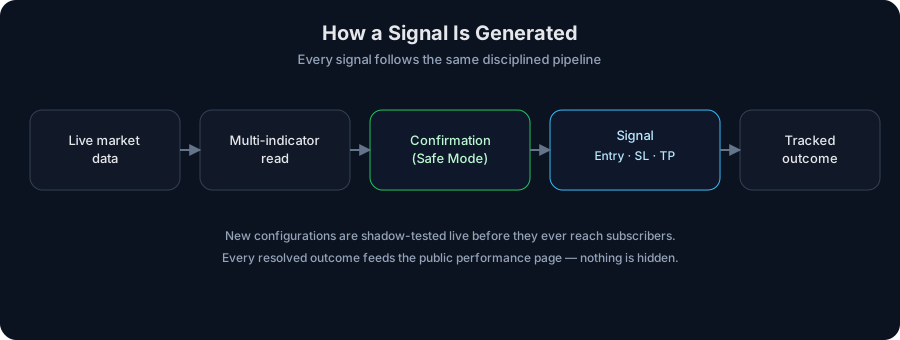
Everything starts with clean, reliable price data. ETH Signal ingests live candles for ETH, BTC and SOL from major venues and cross-checks them, because a signal built on a bad tick is worse than no signal at all. Data hygiene isn't glamorous, but it is the foundation the rest of the pipeline stands on.
2. Reading multiple indicators (confluence)
No single indicator decides anything. The engine reads a set of indicators across three families — trend, momentum and volatility — and looks for genuine agreement between them. A move that only looks good on one indicator is treated as noise; a move that lines up across the family is a candidate.
3. The confirmation filter (Safe Mode)
Once a candidate exists, it passes through a confirmation filter we call Safe Mode. This is an additional check that has to agree before the signal fires. It is a deliberate trade-off: Safe Mode gives up a little potential profit in exchange for meaningfully lower drawdown — fewer whipsaws, calmer equity curve. We think that trade is worth it, and we'd rather say so plainly than dress it up.
4. Defining the trade: entry, stop loss, take profit
A verdict on its own is not a trade. Every ETH Signal alert ships with a defined entry, a protective stop loss and one or more take-profit targets (TP1/TP2/TP3). Stop and target distances scale with the asset's own volatility so that a 5m BTC setup and a 1H SOL setup are internally consistent. Terms like entry, SL and TP are defined in our glossary.
5. Timeframes
The same engine runs on several timeframes — 5m, 30m and 1H — and each one behaves differently. 5m is fast and busy; 1H is slower and more selective. We treat them as distinct products with their own thresholds rather than pretending one setting fits all. A full comparison lives in 5m vs 30m vs 1H crypto signals.
6. Testing before it goes live (shadow validation)
New configurations never go straight to subscribers. They first run live but unpublished — we call these shadow signals — and their outcomes are recorded exactly as if they were real. A shadow lane must clear a strict promotion process (backtest, forward-test, manual approval) before anything is broadcast. Plenty of candidates fail this step; that is the point.
7. Transparent tracking
Once a signal is live, every resolved outcome — win or loss — feeds the public performance page. Nothing is filtered out. The exact methodology we use to score results is documented in how we measure performance. If a lane underperforms, it shows up there; if we retire it, we say so.
What this is not
Signals are not guarantees. They are structured, disciplined opinions about probability — nothing more. Position sizing, leverage choices and overall risk management remain the trader's responsibility. Read our risk management guide before putting real capital behind any alert.
FAQ
How are ETH Signal's crypto signals generated?
Each signal comes from a rule-based engine that reads several indicators across trend, momentum and volatility, applies a confirmation filter, then defines a clear entry, stop loss and take profit. No signal relies on a single indicator.
Are crypto trading signals guaranteed to be profitable?
No. No signal service can guarantee profit; markets are uncertain and losses are part of trading. ETH Signal focuses on a disciplined, transparent process and publishes real resolved outcomes rather than promising wins.
What is Safe Mode?
Safe Mode is a conservative configuration that adds an extra confirmation before a signal fires. It gives up a little potential profit in exchange for meaningfully lower drawdown, a smoother, less volatile result.
How do you test new strategies before using them?
New configurations run live but unpublished ("shadow" signals) and must clear a strict backtest-then-forward-test-then-manual-approval process before any subscriber sees them.
Is this financial advice?
No. This page is educational only. Crypto trading carries significant risk of loss and nothing here is financial advice.
Want proof rather than promises? See every resolved outcome on the performance page.
Risk Disclaimer
This article is educational content only and is not financial, investment or legal advice. Cryptocurrency trading carries significant risk of loss. Past performance of any signal does not guarantee future results. Always do your own research and consider consulting a licensed financial adviser before making investment decisions. Never trade with funds you cannot afford to lose.